How BeamMe reads you back to yourself
Each time I open my phone, an archived photo pops up and reminds me of a memory I'd forgotten. Invariably I smile. I was there. I took that photo because that moment — which was over in a click — mattered.
What if I'd had a camera to record all the work moments that mattered during my decades-long career? My CV, my diplomas, and my bank statements record the outcomes of my work. They're the salary already spent. They hold none of the effort, the challenges, the moments of pride and sometimes the letdowns, of my work.
For most of my 35+ year corporate career, I missed that gap. My CV is a solid thread of employers who validated the worth of my work. My credibility was based on a rental agreement. The specific value only I could have brought to the table was missing.
I built BeamMe to close that gap.
The intelligent work log: what shifted because you were there
You can, and hopefully already do, keep your achievements in a journal or a brag doc. A BeamMe™ log starts the same way. It asks you: "What's a moment that mattered?"
In most journals, you'll say I shipped the thing, I wrote the blog, I closed the deal, I landed a new client — and that's where the conversation ends.
BeamMe is different because whatever you wrote down will trigger a question that makes you think deeper about the thing you logged.
If you made a decision, BeamMe will push you on the choice you made, the choice you didn't make, and why.
If there was tension in the room, BeamMe will want to know about the competing priorities, the trade-offs, and what you had to give up.
If you made a judgment under uncertainty, it will ask how you navigated ambiguity when the answer wasn't clear.
If what happened surprised you — what didn't go the way you thought it would?
If other people were involved — how did their dynamics shape what was possible?
Here is what that looks like in practice, from my own record.
I logged about offering someone a founding role. The question asked what made me propose that seat.
I logged about working with a leader who backed me. The question asked whether that trust already existed or whether I had to earn it.
I logged a moment from early in my career, when an important woman supported a young professional. BeamMe asked me what changed inside that room — the one I entered so nervous I was sweating, and walked out of with my first big breakthrough as a journalist.
What your logs power
Just like today's digital photo archives tell stories about the moment the camera went click, each log in BeamMe is a point in the compounding story of your professional journey.
As you answer one or two questions, BeamMe helps you reflect, and then gives you two readings: an insight, and a note about what it thinks that moment says about you. You can agree, or push back and have it rewritten. And when the record doesn't support a claim, BeamMe says nothing rather than making something up — a read you can't trust everywhere is a read you can't trust anywhere.
Once you commit that moment to memory, it becomes stored evidence of the value you bring. Each log is a layer in a compounding set of points that translate into your professional equity — and the first payoff, after about five logs, is your Work Signature™: the recurring pattern in how you solve problems, make decisions, and contribute across situations.
As your record grows, so does its value to your professional life. Take a role you're considering: BeamMe reads your record against that specific job and tells you what bet the company would be making on you — including the part it can't support, because you've never logged it. The same evidence prepares you for a review, or becomes a post in your own words. You write nothing new. The questions change; the record doesn't.
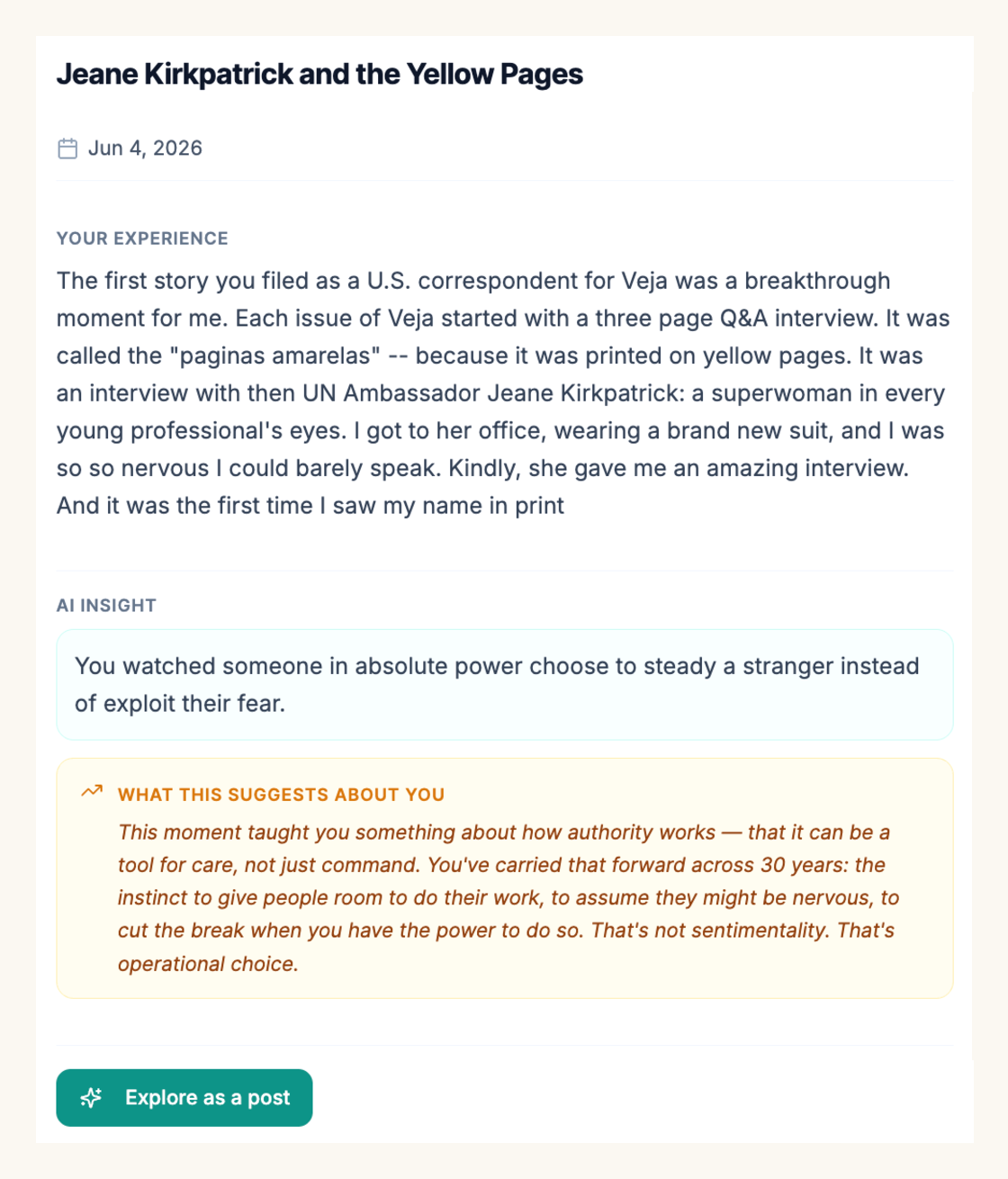
Which brings me back to the log I mentioned earlier, the one from early in my career. I logged that moment because it mattered to me, not because it proved anything. BeamMe read an operating principle out of it — one I'd been running for decades without ever naming — and called it something I never would have. "That's operational choice."
It is. And it's why I'm building BeamMe — to give everyone room to do their work by bringing their strengths to the fore.
Frequently asked questions
How is BeamMe different from a journal or a Notion setup?
Notion rewards whoever builds the perfect structure and punishes everyone else. BeamMe has none to fall behind on — no tags, no folders, nothing to maintain. But the real difference isn't filing. It's what gets written down, and what comes back.
A log is a conversation, not a blank page. You say what happened — spoken or typed, a sentence is enough — and BeamMe asks the one or two questions worth asking while it's fresh. Those answers are the part you'd never have written unprompted, and they don't survive the month. You can always retrieve what happened. You can't reconstruct how you were deciding at the time.
Every entry comes back read. What it suggests about you, anchored to your own words, from the very first one — and if the read is wrong, you say so and it rewrites. A notes app gives back exactly nothing.
It wants the moments a highlight reel skips. The meeting that went sideways, the week that drained you, the problem you reframed on the walk home. The patterns live in exactly the moments you'd never put in a brag doc — which is why a brag doc can't tell you who you are at work.
I work on confidential things. Can I still use BeamMe to log my work?
When BeamMe asks you what happened, it's only interested in how you think and operate, not the confidential details of what you worked on. You log how you spoke up in a meeting, not the meeting's contents. You log how you navigated a conflict, not who it was with. You log how you decided under pressure, not the proprietary information behind the call.
What you do log is yours alone — no feed, no followers, never training data for any AI, and never shared with an employer, recruiter, or advertiser. That holds even if BeamMe is ever acquired. BeamMe's privacy policy has the details, including every company that touches your data and how to export or delete all of it, any time.
Can logging help with imposter syndrome?
Imposter syndrome has a memory problem. When you doubt whether you're as good as other people think you are, it's remarkably easy to remember the mistake, the lucky break, the thing you still don't know — and forget the hundreds of judgments and decisions that got you here.
BeamMe doesn't tell you that you're brilliant. It keeps the evidence.
Every log holds something that happened: the call you made, the problem you noticed, the trade-off you navigated, the thing you tried that didn't work and what you did next. As those moments accumulate, BeamMe can show you patterns that are difficult to dismiss as luck — because you've done them repeatedly, in different circumstances, over time.
And BeamMe isn't designed to turn everything you do into proof that you're wonderful. You can push back on its reads. Some experiences won't support your Work Signature at all. Others may challenge what BeamMe thought it knew about you. That's part of keeping the record honest.
So when the voice in your head says I have no idea what I'm doing, BeamMe doesn't answer yes you do. It shows you the record.