Am I qualified for this job?
I was three hours into the endless scroll for a dream job — or at least a job worth applying to — when I found one: Director of Communications at a major university library system.
I'd just left a communications leadership role at a peer institution, and this job posting checked the boxes: institution, commute, pay. Having worked in virtually every part of a university except a library, I began constructing the obvious case: everything I had done had led me here. I tried to summon a convincing passion for libraries.
Left to my own devices, I would have led with my thin subject-matter expertise and hoped they wanted a nice lady with a library card — which, to be honest, I haven't had in years. So I'm glad I got a second opinion. I was solving the wrong problem.
Should I apply if I don't meet all the requirements?
Underneath that question is another one: Am I good enough?
It's a deeply human question, but it won't help you decide whether to apply. No job posting, chatbot, or amount of résumé rereading can settle your worthiness debate.
What can be answered is different: What does this role need, and what does my record show?
Job descriptions combine essential needs, preferred experience, and an organization's picture of the ideal hire. They're no more precise than a horoscope; anyone who reads one and moves forward confidently does so by suspending a little disbelief.
Your own recall isn't much better. Memory rewrites everything, making you look far better or worse than you were — and it is often least reliable about the work that comes most naturally to you: the second-nature habits that feel too obvious to mention. You're good at what you do — probably better than you can see. There are no grades for this exam.
What I did instead
After several failed attempts at a cover letter, I gave the posting to BeamMe's Opportunity Fit. It read the role against my CV and the moments I had been logging.
I expected it to validate the strengths I already planned to emphasize: needs assessments, narrative development, website launches, writing.
Instead, it led with this:
"Read against this role, your strongest asset isn't communications leadership in the abstract — it's the specific muscle of making a decentralized academic enterprise feel coherent to outside audiences without owning the units inside it."
In twenty years across a sprawling university, I had never described myself that way. Coordinating with colleagues across schools, centers, and administrative offices is something I do the way I breathe. I had filed it under personality, not skill. Because it came easily, I assumed it was nothing special.
Opportunity Fit named it as the precise capability the role required, and I wasn't even planning to mention it.
The gaps — real and otherwise
A fit read that glossed over my weaknesses would be useless. BeamMe™ identified a real gap: the role oversees a video production operation, while my record shows partnership with videographers, not management of teams. Fair point to bear in mind.
But the two other gaps surprised me.
The read called me out on lacking digital accessibility expertise, and yet I had led the development of accessibility guidelines a few years before. But apparently I'd neglected to write it down.
It also found little evidence of long-term communications planning, which I have done for years. But my résumé was organized around events and initiatives with tidy end dates and clear metrics. In my effort to lead with results, the big picture had disappeared.
Those gaps in my documents could be fixed. Opportunity Fit helped my résumé catch up with my record.
The role that got away
Curious about its insights, I tested Opportunity Fit against a role I had already lost.
A month earlier, I had applied to lead communications for a women's leadership organization. The match seemed obvious. They wanted to build thought leadership; I had spent much of my career writing about thought leaders. They were teaching AI skills to members; I had led communications about AI research.
After a friend even put my résumé in front of the CEO, I was sure it was mine. The screening interview, which I told everyone I nailed, felt like a formality. I was already mapping out my first 90 days in the role.
When the rejection email arrived two days later, I thought it must be a mistake. I forwarded the no-reply message to the recruiter's real address. When she declined to offer feedback, I fell into the familiar explanation: not good enough.
A month later, Opportunity Fit showed me something I had missed.
The posting described the organization as venture-backed. I had treated that phrase as background detail. For this role, it named a meaningful stakeholder group and spoke to an environment of high growth expectations, shifting priorities, and a particular set of VIPs to keep happy. Opportunity Fit showed me how that detail shaped the bet the organization would have needed to make on me.
When you spend your career in one sector and look to make a switch, you don't know what you don't know. Looking at that bet, I could suddenly see the case I should have made — years of working with boards and donors, barely mentioned — and how narrow my polished argument had been.
I will never know why I didn't advance. But if I had considered the bet before applying, I would have made a different case.
What Opportunity Fit does
You give Opportunity Fit a job posting. It reads the role's underlying needs against the professional record you have given BeamMe.
Then it describes:
- Where your experience aligns
- Where your record supports a stronger claim than your résumé makes
- Where the evidence is thin or missing
- Where a gap appears real
- What the company would be betting on by hiring you
If BeamMe has misread your experience — or if you left out important evidence — you can push back. It reconsiders the read against the record and explains what changed.
There is no score, percentage, or verdict. BeamMe describes what your record shows; it never grades you.
The question, dissolved
I never got an answer to Am I qualified? Instead, I got a better question: What is the honest case, and do I want to make it?
For the library role, the read gave me a case grounded in a strength I had never counted as one. Within the hour, I had emailed a friend who worked there, learned more about what the job really involved, and got started on my application.
I had a strong first interview. I'm hoping for round two next week.
Sometimes a clear-eyed read ends an application. Sometimes it exposes a real gap. Sometimes it reveals that your experience is stronger than the documents representing it. You just needed a broader perspective to point that out.
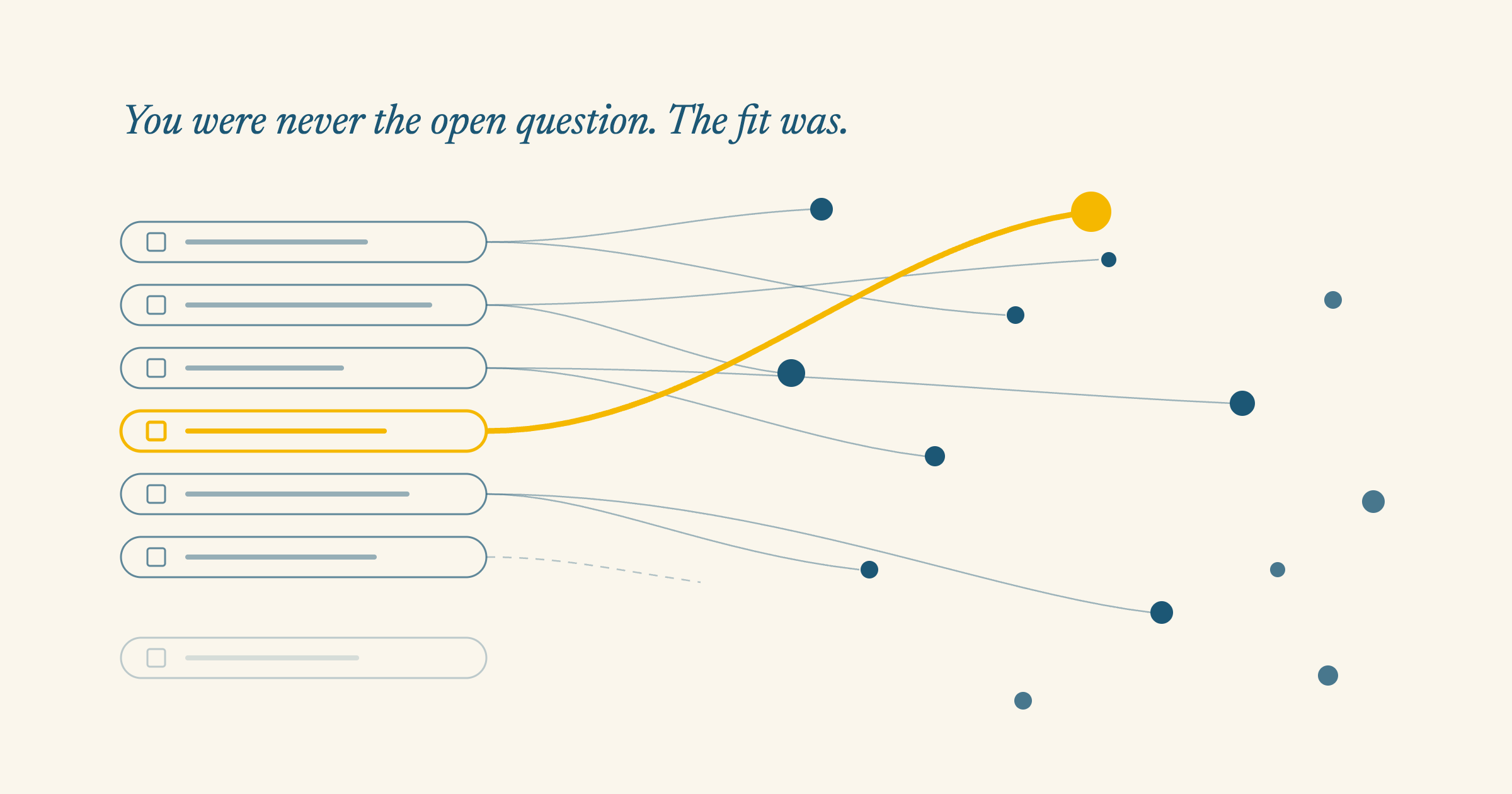
You were never the open question. The fit was.
Frequently asked questions
Should I apply if I don't meet all the requirements?
Not meeting every listed preference does not automatically make you a poor fit. Look at the role's underlying needs, the evidence your record provides, and which gaps would matter most to the employer. Then decide whether there is an honest case you want to make.
Is Opportunity Fit a score?
No. There is no percentage, grade, or qualifying threshold. Opportunity Fit describes where your experience aligns, where the evidence is missing, and what the company would be betting on by hiring you.
What does Opportunity Fit need from me?
It needs a job posting. A CV makes the read richer, and so does every moment you have logged — those experiences can supply evidence that never made it into your résumé.
What if the read shows a weak fit?
First, look closely at the gaps. Some may be missing experience; others may be experience you never recorded. A weak read can also help you decide when not to apply. That has saved me many hours.
Why not paste the job description into a general-purpose chatbot like ChatGPT?
A general chatbot works with whatever you bring into the conversation — and it tends to deepen the groove you're already in, arguing your side back to you and smoothing over missing evidence with a plausible interpretation. Opportunity Fit is constrained to your evidence but not to your perspective: when the record doesn't support a claim, it says so, and it reads the role with knowledge your own sector never gave you.
Anna Spinner spent twenty years leading communications across a major research university. She is a Founding Member of BeamMe.