How to prepare for a performance review
How to prepare for a performance review (with evidence, not memory)
It's performance review time. Again. You may be asking, "Didn't we just close a cycle?" Or, "Have I had time to do anything else relevant since?"
You know how busy you've been. But, off the top of your head, what, exactly, rises to the top of the 3–5 accomplishments you will list? How do you make the case that your team, company, or client is better off because you were there?
Preparing for a performance review comes down to one question — what changed because you were there? — and answering it with evidence rather than memory.
Performance reviews, annoying as they can be, are a rare opportunity: to show the targets you exceeded, to explain the ones you missed for reasons beyond your control, and to have a conversation that clarifies where you should be spending your time during the next cycle.
So you'll sit down with your laptop and search Slack, Gmail, and your Drive. You may even have kept a journal or a brag doc of raw notes on your accomplishments. Yet, because our memory plays tricks on us, what you'll find in that backlog will likely be missing the human context behind it: what happened because of a decision you made, judgment you exercised, and resistance you overcame.
And increasingly, your manager may be looking at some of the same workplace evidence — with AI helping them form their own view of what you accomplished. The question worth asking is what you'll walk in with.
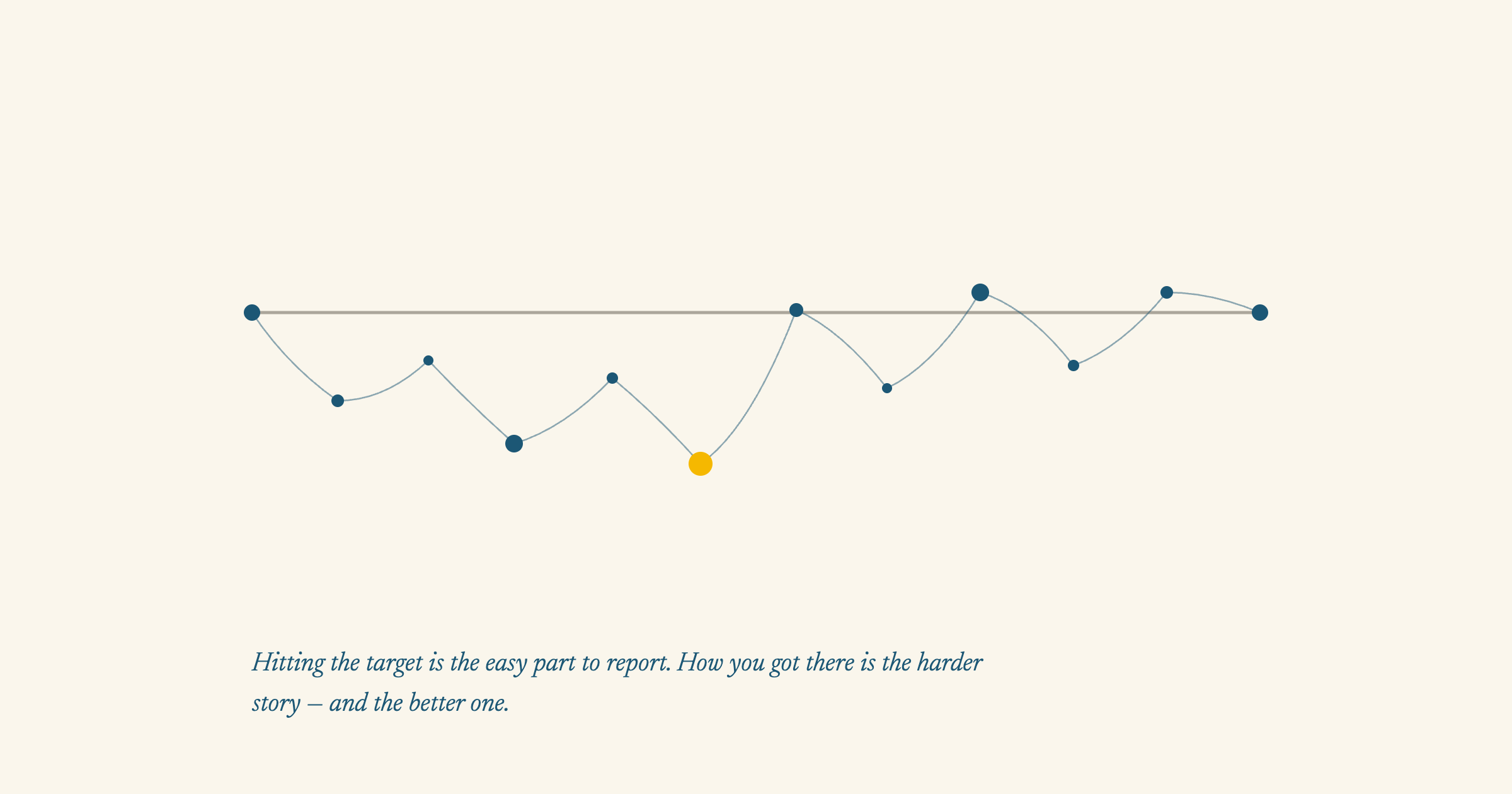
Answering the question: what changed because I was here?
To build a robust case for yourself, you need to keep an intelligent record of what you did. You build that record in BeamMe by logging moments that mattered — something that surprised you, annoyed you, or made you proud. One sentence is enough to start. Record it in your own voice, or type it if you'd rather. BeamMe reads what you logged and asks you at most two follow-up questions. It will offer you an insight. If you agree with what BeamMe inferred, you archive it.
When it's time to prep for your next review, BeamMe™'s Performance Review Prep will start by asking you a few questions — who the review is with, when it happens, what period it covers, what you're going for, and what you want this review to demonstrate about how you work. That last one matters most: it's what BeamMe's read gets anchored against. If you answer too generically, BeamMe will press you. Instead of anchoring on what your manager wants, BeamMe is more interested in what you want. Don't worry — BeamMe will never judge your goal as too ambitious!
Your answers determine which conversation you'll be able to drive. You can either prove value — what changed because I was here — or show trajectory — what changed in how I work. BeamMe infers this from your audience, your tenure, and whether you're looking to demonstrate a what or a how.
Only then will BeamMe spend a few seconds reading your record and hand you a brief in three sections. The Value: one carryable sentence — sixty words or fewer — answering what changed because you were here. The Pattern: the through-line across your work. The Strain: where the evidence runs thin for what you hope to show — sometimes including something about how you've been logging that you were too busy to notice. All of it backed by specific experiences you chose to record because they mattered.
And because BeamMe asks when the review actually happens, the brief closes with what to do between now and then.
Frequently asked questions
What if I'm late, again?
BeamMe has been designed to hold your judgment without ever judging you.
If you're here because your review is tomorrow, do this: sign up for BeamMe and log the five moments from the last quarter that you do remember, one at a time. Answer BeamMe's questions. Push back if you need to.
BeamMe will read them and give you something to carry into the conversation with your manager — and then help you understand what you bring to the table, during review season or any other moment when you need to show how good you are at what you do.
How is AI changing performance reviews, and what can I do about it?
AI is moving fast into HR: according to SHRM's 2026 State of AI in HR report, 39% of organizations have implemented AI in at least one HR activity. More managers are using systems that aggregate employee metrics and help draft review narratives.
That increases the urgency of keeping your own record. As Harvard Business Review notes, companies are using AI to produce more polished versions of their narrative about you, faster. Which means that, ironically, managers are running the same risk you are by asking AI to help when the time comes.
BeamMe starts elsewhere: with evidence created each time you log what matters to you, and why you mattered to what happened. The future of performance reviews shouldn't be better-written reviews. It should be better evidence.
How many experiences do I need before Performance Review Prep becomes useful?
There's no minimum: Performance Review Prep works from your very first log. But the read is only as strong as the record behind it — one experience gives BeamMe a data point; a season of them gives it a pattern. That's true of every BeamMe feature: the more you've logged, the sharper the read.
The number that matters most is how many entries fall inside the period your review covers. Experiences from outside the period still count: they show the patterns you carry forward — the professional equity you've built over time.
If the period your review covers is thin on entries, BeamMe will tell you without mincing words — and give you the opportunity to log something you may have left out.
What if my review is mostly about goals and metrics, not how I work?
BeamMe will understand that's your case from information you chose to share: your audience for the conversation, your tenure, and what you say you want to show. If the review is about organizational impact, BeamMe frames the read around one question: what changed because I was here.
BeamMe doesn't collect your metrics. No field asks for your revenue number or whether you hit the target — those live in your own systems, and you'll bring them yourself.
What BeamMe holds is your account of how those numbers came about — including any number you chose to log inside an experience. The decision you made in week three, the approach you rejected, the thing you fixed before it became visible. That's the narrative a metrics dashboard can't show, and your self-eval usually flattens — and it's what turns "we hit the target" into a case only you could make.
Can BeamMe help me prepare for a difficult review, not just a good one?
It's arguably built more for that one.
The intake asks about friction — what concerns this person has raised, what they want different from you — and, if you've reviewed with this person before, what you agreed on last time. When friction is present, it shapes the whole read.
Each brief comes back with a section called The Strain: it names where the evidence is thin or where the reading could go against you. If the record doesn't hold what you need it to hold, that's what The Strain says.
BeamMe names the one specific thing worth recovering before you walk in — anchored to what this particular person will be reading for.